
TL;DR
- Independent firms with a defined ideal client, a clear value proposition, and a written marketing plan gained 87% more new clients and 127% more new client assets in 2025 than firms without them. That is data from Charles Schwab’s 2026 RIA Benchmarking Study.
- The value proposition and the ideal client profile are the foundations the marketing plan gets built on.
- Targeted marketing paired with a deliberate referral strategy is the engine of organic growth, a factor that can lift valuation multiples when a business is ready for sale.
- Advisors can own and execute a marketing plan in-house or hand it to a partner. What matters is that a real, written plan exists and you can execute it to reach your ideal client with the right message.
Do you have a marketing plan?
Does your marketing plan exist as a real, written thing? Or is it a vague understanding of tactics you assume everyone on your team shares?
The harsh truth: If it isn’t written down, no one knows it. And the cost? Lost clients and lost AUM growth.
What Schwab’s data says
Schwab’s 2026 RIA Benchmarking Study puts a hard number on what marketing is worth to independent advisors. Firms with a defined ideal client, a clear value proposition, and a written marketing plan gained 87% more new clients and 127% more new client assets than firms without them last year.
Read that again. Not 12% more. 127%! More than double.
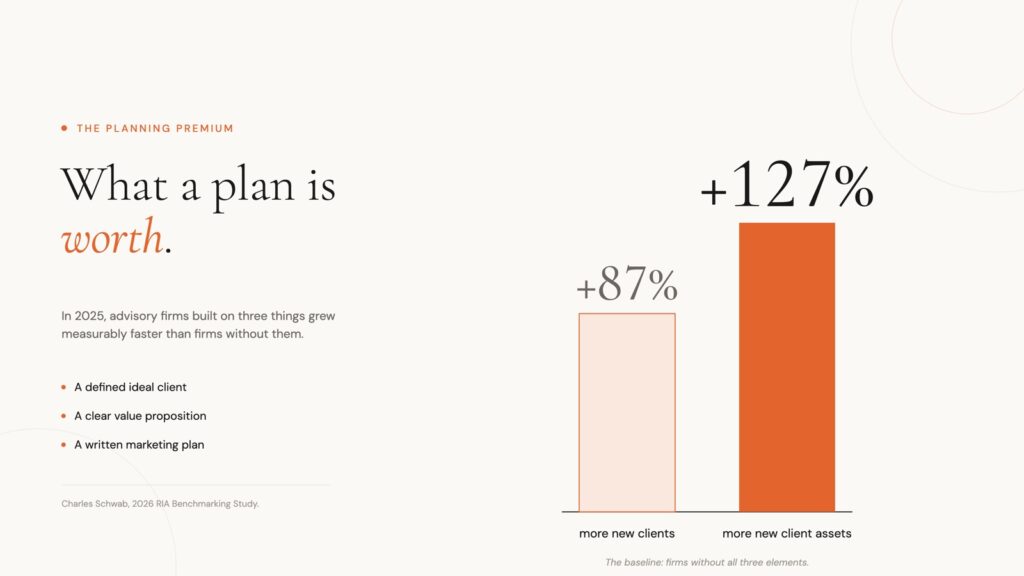
In contrast, across the whole study, firms grew their client base 4.7% and assets by 17%1. The data is U.S. centric, but the lessons apply for Canadian independent advisors just as well.
That gap is the story: for the average firm, a rising market lifted the assets already on the books, while new clients made their way to firms that were clear on their value offering and were reaching their target client effectively.
Disciplined firms tend to run tighter everywhere, operations, client service, client experience, etc. But that’s the point. Clearly identifying a target client and knowing how to truly serve them are foundational to the marketing discipline. The marketing plan is where the discipline becomes visible and repeatable, driving growth.
Why a clear marketing + referral strategy compounds growth
A referral program on its own is great. But it isn’t enough. A marketing plan tells your referral sources (e.g. business partners and centres of influence, existing clients) exactly who to send you. It aligns your team so they deliver one story (your elevator pitch), and it points every dollar at your defined client market instead of just anyone.
Additionally, organic growth doesn’t just fuel revenues for the current year. Schwab’s analysis infers that even a small, sustained lift in organic growth compounds into materially higher enterprise value by the time you sell. A report by Mercer Capital reinforces it for US RIAs. Buyers pay a premium for growth they believe will continue, because it signals business strength and durability.2 Conversely, they would discount valuations if growth was really just driven by a rising market, or highly dependent on the founder.
Start with the foundation, not the tactics
A marketing plan is a written strategy built on three answers: who you serve, why they choose you, and how you reach them. It’s not a to-do list of tactics.
- Who is your ideal client, specifically?
Not “high-net-worth families.” A defined persona: their life stage, what keeps them up at night, what makes them tick, where they look for information, the moments they go looking for an advisor. - What is your value proposition?
How will you solve their problems, and why should they choose you over the firm down the street or the bank that just bought a trust company? - How will you reach them, and where is their attention?
The channels you will adopt, and your communication and publishing cadence.
Measure your marketing efforts. Identify the handful of measures that tell you to keep going or stop. This will help you see clearly what tactics drive results.
Here’s how this might look like for two different client profiles, side by side:
| Client Profile A: Gen X women dealing with a major life shift | Client B: Business owners within five years of selling | |
|---|---|---|
| Who they are, their fears, and what drives them | Professional women, roughly 48 to 58. Divorced, widowed, downsized or choosing to leave corporate life. They have their own assets/accumulated wealth and are managing money on their own terms (sometimes for the first time). They fear running out, starting over, getting it wrong at fifty-two. Trigger moment: divorce, alimony/child support payments, corporate settlement packages, a parent who now needs care. | Founders roughly, 55 to 65. Most of their net worth is locked in a business they plan to sell within 5 years. They are asset-rich, liquidity-poor, facing the biggest financial event of their life. They fear leaving money on the table, a botched/over-taxed exit, lost identity. Trigger moment: the financial offer for their business, a health scare, the business partner who wants out. |
| Value proposition (one spoken sentence) | “I help women rebuild a financial plan around the life they actually want next, not the one they were on track for.” | “I help owners turn one illiquid business into a plan that funds the next phase of their life and protects what they built.” |
| How you reach them | Women’s professional networks, targeted intimate events, and alumnae groups. Referrals from divorce lawyers and career coaches. LinkedIn, Instagram, and email. Content that names her exact moment and leads with advice. Relationship-first, relatable langauge. | Referrals from COIs (M&A advisors, accountants, and business lawyers). Exit-planning events, peer-owner groups, and boards. LinkedIn and email. Content that addresses the sale: the years around it, valuation, tax, exit strategies. Relationship-first. |
| What to measure | Steady publishing cadence Inbound conversations Referral sources, not impressions or clicks Qualified introductions from referral partners | |
THE BONUS: Aside from new business growth, there’s one other powerful outcome that comes from getting this right: your client experience strategy starts to fall into place almost effortlessly. That’s a conversation for another post.
Do it yourself, or bring in a partner
Some advisors love the marketing craft and want to own it, and a good use of AI tools now make that far more doable than ever. Others would rather spend that time in the room with clients, and bring in outside expertise for the strategy. Both work. What doesn’t work is doing it off the side of your desk and calling that a growth plan.
If you’ve been treating marketing as a cost to trim rather than a lever to pull, it may be worth a fresh perspective and a conversation to help turn a scatter of tactics into one clear, documented strategy that connects to how the business actually grows.
Let’s connect.
Cheers,

Sources:
1. Charles Schwab, 2026 RIA Benchmarking Study. A survey of 1,236 firms representing $2.5 trillion in AUM, participated in the 2026 study. Study ran in Q1 2026, for the 2025 period.
2. Mercer Capital, “Organic Growth Is the New Scarcity Premium,” RIA Valuation Insights, May 2026: